Halton Arp published the Atlas of Peculiar Galaxies in 1966, a catalogue of 338 interestingly shaped galaxies or galaxy groups that don’t look like your typical elliptical or spiral! I thought I’d share my 5 favourite galaxies from the atlas, and explore why they look so weird!
Let me know your favourites and tell me if there’s a galaxy you think I missed!
Fornax A
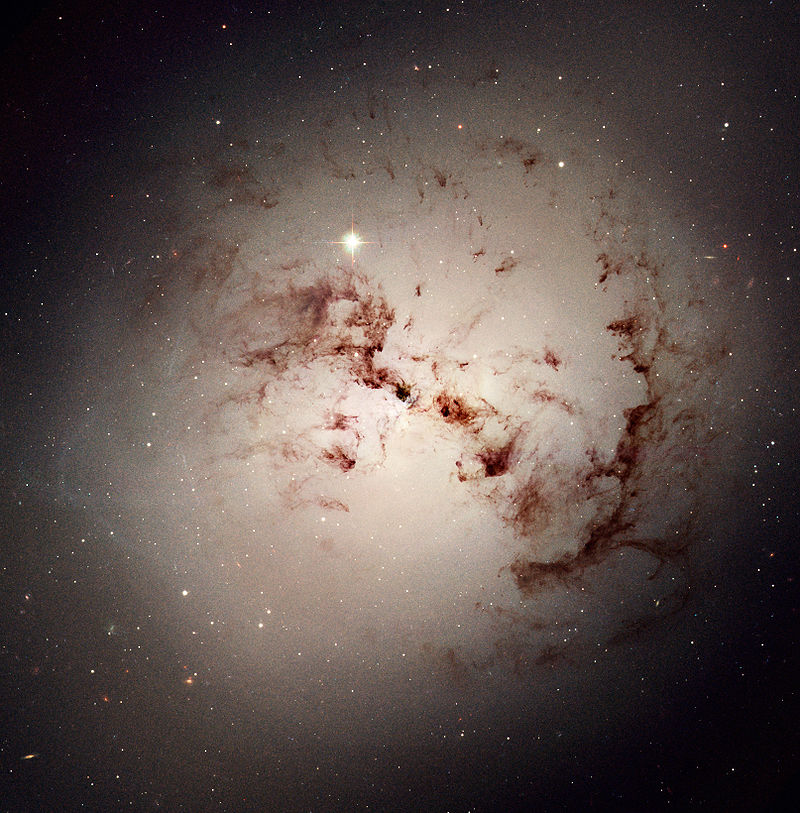
Fornax A is a lenticular type galaxy (that is a mashup of elliptical and spiral galaxy) in the Fornax cluster. To me, it seems to have mostly elliptical characteristics, but it has some rather unique dust lanes that ripple outward from the centre.
Typically in a cluster, the biggest and “dominant” galaxy is labelled the A galaxy, such as in the case for Fornax A, however this galaxy is actually a bit on the smaller side. It has a diameter of 15’000 parsecs, which for context is about half the size of the Milky Way, and the Milky Way isn’t exactly a giant galaxy either!
Lenticular galaxies in general aren’t as well understood as ellipticals and spirals, but there is some clue as to how the galaxy came to look the way it does. The most likely cause for Fornax A’s structure is likely that it is the result of two or more galaxies colliding and settling down into a new galaxy. It isn’t particularly common to see a merger this late in the merging since it takes billions of years for this process to happen, which is already a large portion of the age of the universe!
Arp 209

Arp 209 (also called NGC 6052) is an irregular galaxy pair, and I won’t lie, I couldn’t see two galaxies in this either! While Fornax A is at the end of merging, Arp 209 is right in the middle of the process. This explains the weirdly messy spiral arms, which ironically are no longer in a spiral.
At this point, there aren’t really two defined centers anymore and the arms of the former galaxies are becoming more dispersed and undefined. I think one galaxy was likely the pure blue bit on the right side, and the other galaxy was the brownish blue bit on the left.
Mayall’s Object
When a galaxy is called an object, you know there’s going to be some chaos!
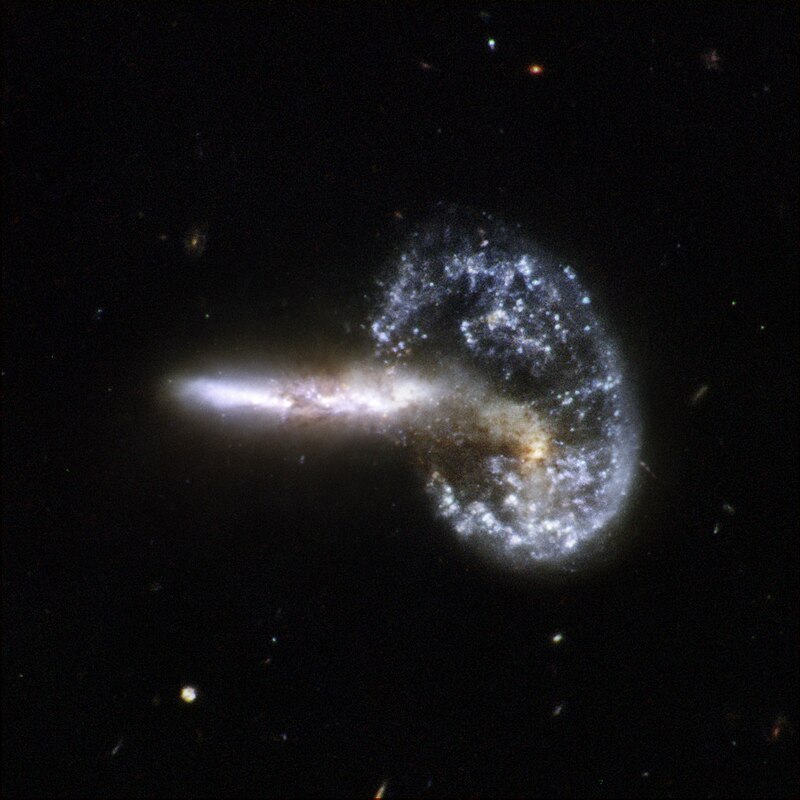
Arp 148 (also known as Mayall’s Object) is an intriguing case. Here we see two galaxies that have collided at 90 degrees to each other. How unique!
Astronomer have seen a lot of cases like these before, one absolutely stunning example of a ring galaxy is Hoag’s Object and that is one peculiar galaxy!
It’s not necessarily the 90 degree collision here that’s going to create a ring galaxy. What’s really important here is that one of the galaxies passed straight through the centre of the other. This cleared out the centre of the right galaxy and create the ring, with the left galaxy forming a tail.
Arp 142

Arp 142 was originally classified as a galaxy triplet (but it’s actually not, we’ll get into that later!). NGC 2936 is the really striking red and blue galaxy that, looks like capillaries on an eye to me.
This galaxy is in the early stages of interacting with NGC 2937, the yellow elliptical below it. The tidal forces between both galaxies is what has bent the top galaxy into an almost-parabolic curve, and has triggered star formation in the little blue veins at the end.
We actually see a similar process happen when a gas cloud or big star gets too close to a supermassive black hole. Sometimes if there’s a lot of gas that gets compressed, it can collapse into a bunch of little stars. Cool stuff!
So where’s the third galaxy? That’s the faint blue long galaxy above the two stars at the very top! It’s actually really far away from the other two galaxies and isn’t part of the system at all, I think Halton didn’t really know that at the time and accidentally grouped them all together. It’s an easy mistake, although it doesn’t exactly look like it’s part of the pair anyways.
Arp 147
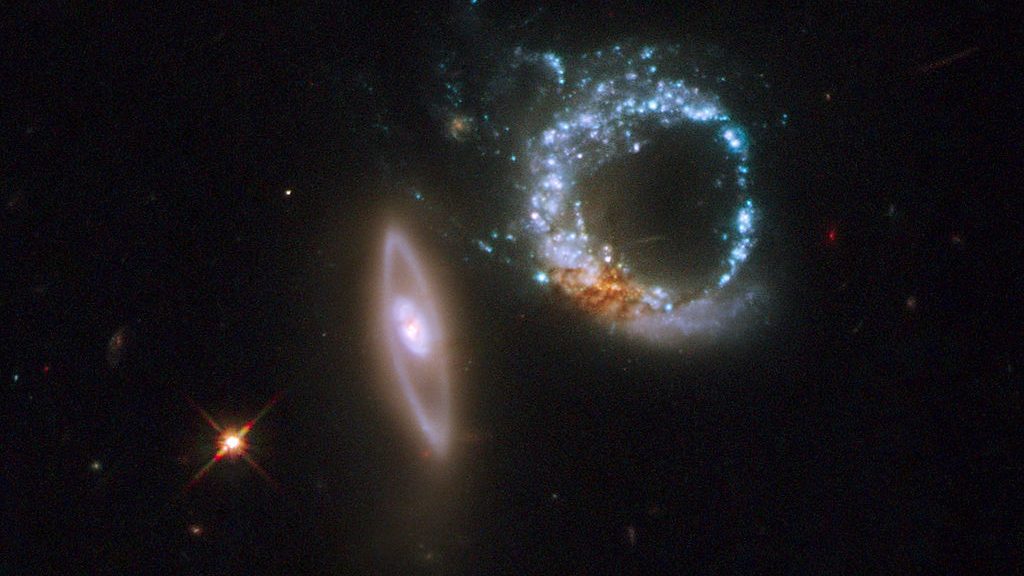
Arp 147 is by far my favourite and when I first saw this I had no clue what was going on! This looks like someone took a bunch of cool galaxies and photo-shopped them together for a cool collage!
Let’s break this one down a bit. On the left we have a star, it is in no way connected to the galaxies to its right. The middle and right are two ring galaxies, what we think happened is the middle galaxy shot right through the centre of the right galaxy and triggered an extreme amount of star formation.
It’s quite a similar case to Mayall’s Object, and explains why the right galaxy has no core (and in my opinion looks very creepy!).
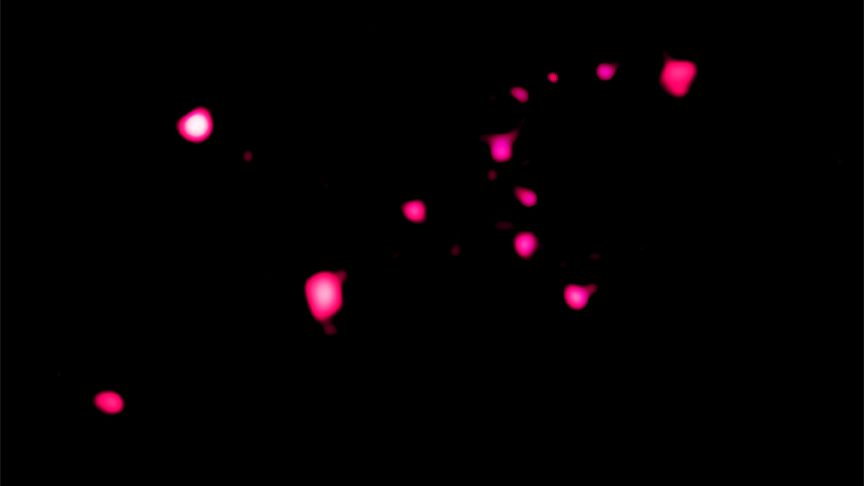
What I think is the most interesting part of this is the fact that we’ve detected not one, not two, but nine stellar mass black holes from the right galaxy. This can be seen from the little pink blobs in the X-ray image from CHANDRA below!
Well there you have it, my top 5 peculiar galaxies. I hope you learnt something new and agree that these are some weird galaxies! Let me know which was your favourite or if you think I missed one out!
 Space With Seti