Recently in the news, the new IceCube neutrino observatory has been making headlines with images of the galactic plane. But how does it do that!?
And why in the Antarctic?
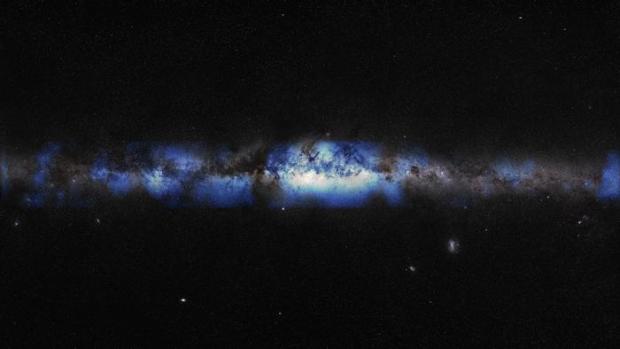
What is IceCube?
IceCube is a neutrino detector in the Antarctic, built in 2010 so a very new observatory. It collects mostly muon neutrinos which are almost charge-less & massless particles that travel at near the speed of light, and are minuscule compared to protons and electrons. Because of this, they’re extremely difficult to detect, which is why we discovered them by looking at the motion of electrons instead!
This was decades ago, however, and with advances in observing particles we now have the ability to observe neutrinos (albeit indirectly and still with difficulty).
How does it do that?
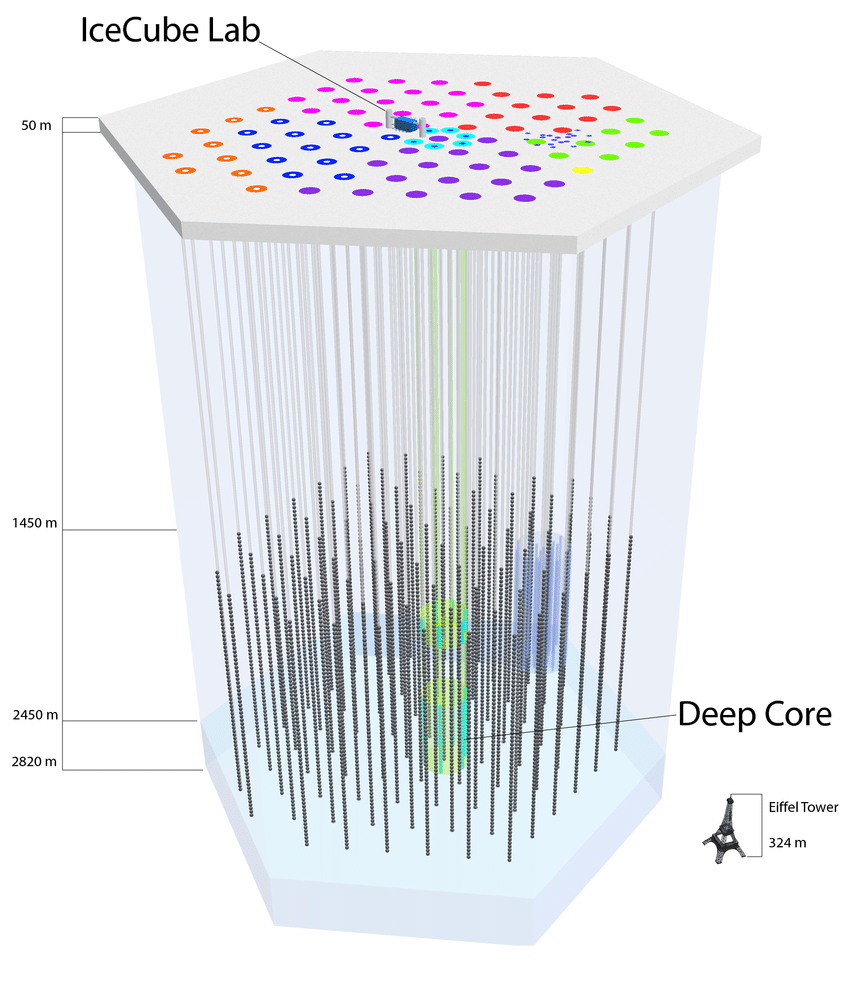
IceCube actually collects data over 1 cubic kilometer of the Antarctic, with detectors up to 2.5km below the surface. The immense size is needed because detecting neutrinos is extremely difficult and a game of chance i.e the more detectors you have, the better chance you have to detecting one neutrino.
Because neutrinos have almost no mass, they can travel at relativistic (speed of light) velocities. When they reach something like water or ice, they can interact with the molecules to create a lepton (electron, muon, or tauon). These should have high enough energy that they emit Cherenkov Radiation, a blue “light” version of a bow shock. This also occurs to far far greater degree when turning on nuclear reactors. It’s very cool, below is a YouTube video showcasing it:
There are a total of 86 detectors in the ice currently, which detect the tiny amounts of Cherenkov radiation and, similar to a radio antenna, amplify it using a photon multiplier. That signal can then be converted to raw data that scientists can use across the globe.
There is also an IceTop facility that looks more specifically at particles from cosmic rays. These particles usually arrive together in (as my old physics teacher described it) a flat pancake of particles.
What is IceCube built to look for?
Neutrinos often form at sites of extreme high energy, which are conveniently the areas of space that we know very little about. Gamma-Ray Bursts (GRBs), feeding black holes, collapsing neutron stars, cosmic rays are a couple examples of areas IceCube could look at.
Supernovae are also sites of high neutrino production. Interestingly it’s the neutrinos, not photons, that arrive first when a supernova happens, despite photons technically being the fastest thing in the universe (except the expansion of the universe itself, don’t get me started on that!)
There is also interest in trying to detect dark matter using neutrinos, as they could be a candidate dark matter particle.
Personally I’m really excited for what IceCube brings us, and I really hope we can find out something about dark matter. That thing just bugs me so much, how is it that we can’t see 80% of matter in the universe!?
Let me know what you think!
 Space With Seti
Love it! We have SO much to learn about the Universe, and we’re just coming up on the the 100th anniversary of Hubble proving existence of galaxies outside of the Milky Way – what will we find out in the next 100?
LikeLiked by 1 person
I somehow didn’t expect Cherenkov radiation to be visible like that. I thought it was detectable with sensors, but not something you could see with the naked eye.
LikeLiked by 1 person
That’s exactly what I thought too! I thought it would be beyond the visible spectrum, but no apparently! Amazing stuff you find in the universe!
LikeLiked by 1 person