In a post a few years ago, we had a look at the latitude and longitude coordinate system, the most popular and simpler system humans have. This time we’ll have a quick look at the most commonly used coordinate system next to latitude longitude: right ascension and declination (with a cheeky hour angle at the end!)
If you read the definition of some of these online, you can get some pretty confusing descriptions that – honestly – only confuse people more, so I’m going to explain this as simply as possible and without sounding like a thesaurus!
Some Terms we Need to Learn
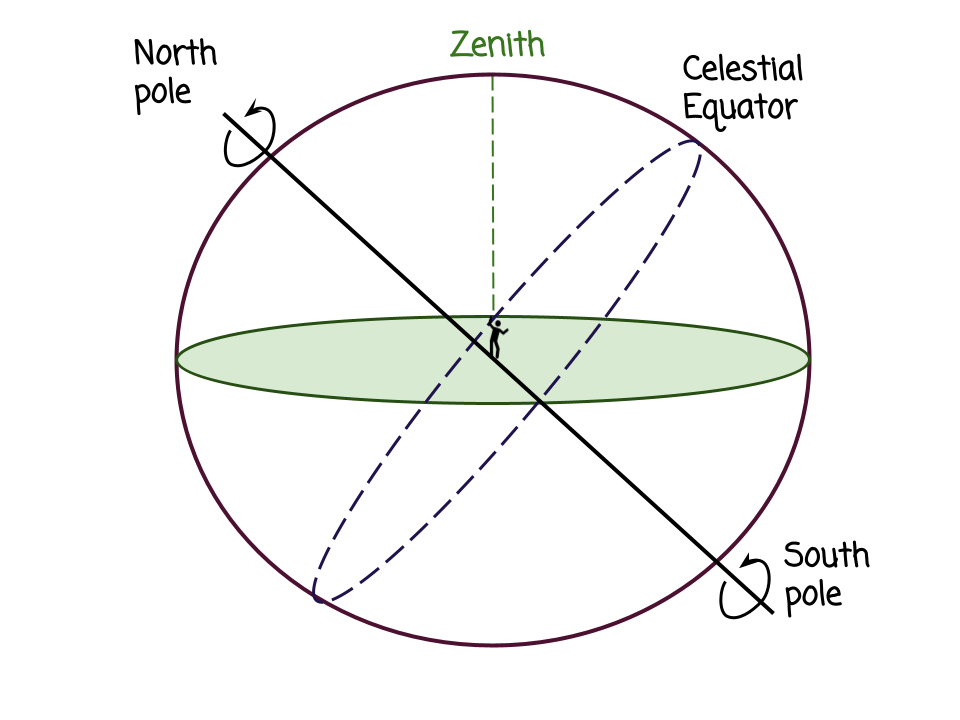
Before we get started, let’s recap on the celestial sphere and some terminology.
Firstly, we have the zenith. This is the point on the celestial sphere directly right above an observer, 90 degrees above the horizon.
The celestial equator is essentially a projection of Earth’s equator onto the sky as the Earth rotates around its North and South poles. You can see in the diagram that it’s at right angles to the poles, just like Earth’s equator. It is basically the sky version of the equator.
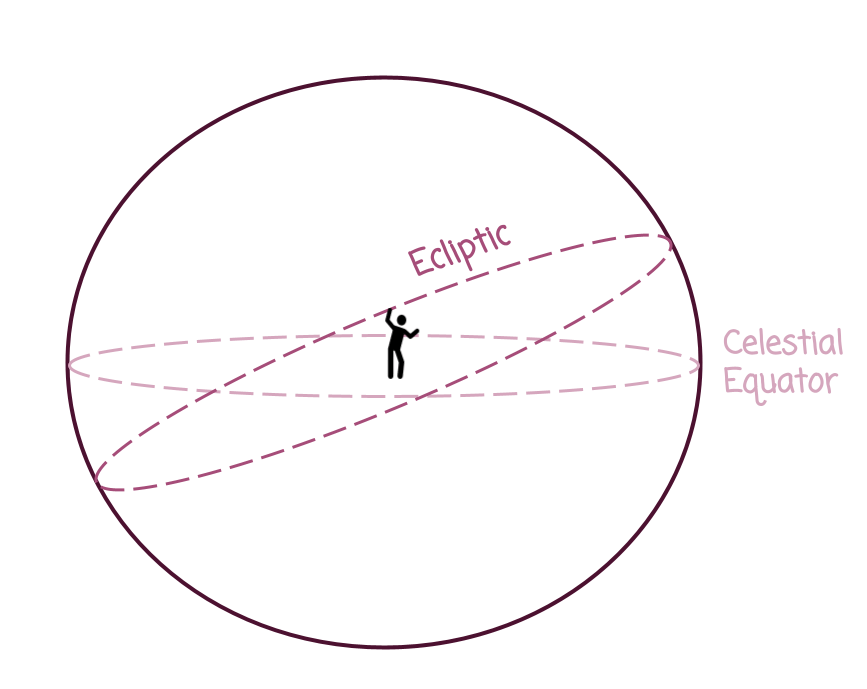
Another important circle you need to know is the ecliptic. This is the path the Sun travels along Earth’s sky across the year. Since Earth is tilted 23 degrees, the ecliptic isn’t in the same place as the celestial equator.
One cool thing is that since the other planets were all made from the same protoplanetary disk, most of them also follow the ecliptic, albeit somewhat roughly.
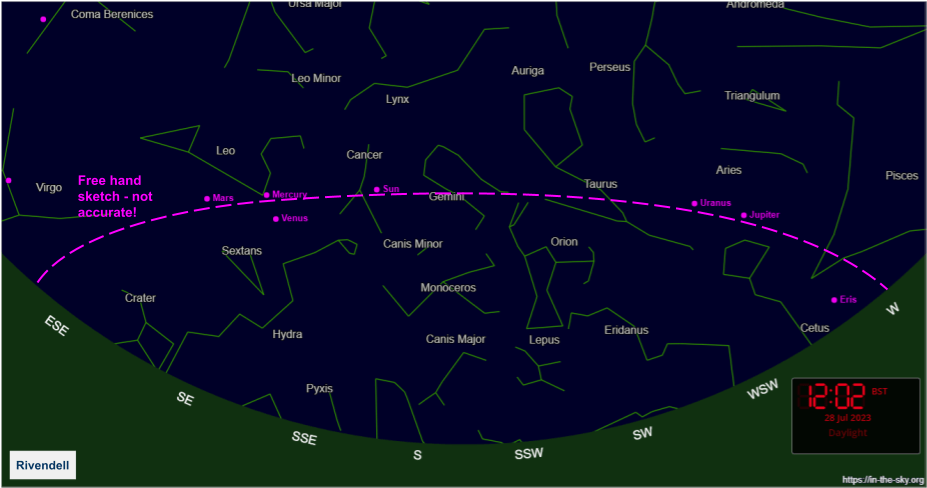
You can see this in the night sky, below is a planetarium image from in-the-sky dot org with a free-hand (aka terrible) sketch of the ecliptic in magenta. The Sun and planets are the magenta dots. The dots nowhere near the line are dwarf planets (Makemake top left, Ceres mid left, Eris bottom right). This is because they have eccentric orbits and don’t follow the ecliptic, they’re just not like other girls planets!
Declination
This one is easiest to learn in my opinion! Declination is simply how far “up or down” an object is from the celestial equator. It is literally latitude, but with the word “celestial” in front of equator.
Below is an example I made up that shows you how it works, as you can see it’s very similar to latitude. Declination can be abbreviated with the Greek symbol delta δ.

The declination has a minus symbol when going towards the South pole. It’s weird since declination sounds like decline or “going down”, I would have thought Southwards would be positive in that case.
Right Ascension
While we do have an easy way to establish declination thanks to the North and South poles, left and right are far more arbitrary and so we need to define a zero point. Right ascension defines this as the point where the celestial equator intersects the ecliptic.
This might sound somewhat meaningless, but this intersection is actually the vernal/spring and autumnal equinoxes, when the Sun crosses the equator! There are 2 spots where it does this, you can see this on the diagram below, but astronomers chose the Vernal equinox as 0. This is also called the First Point of Aries.
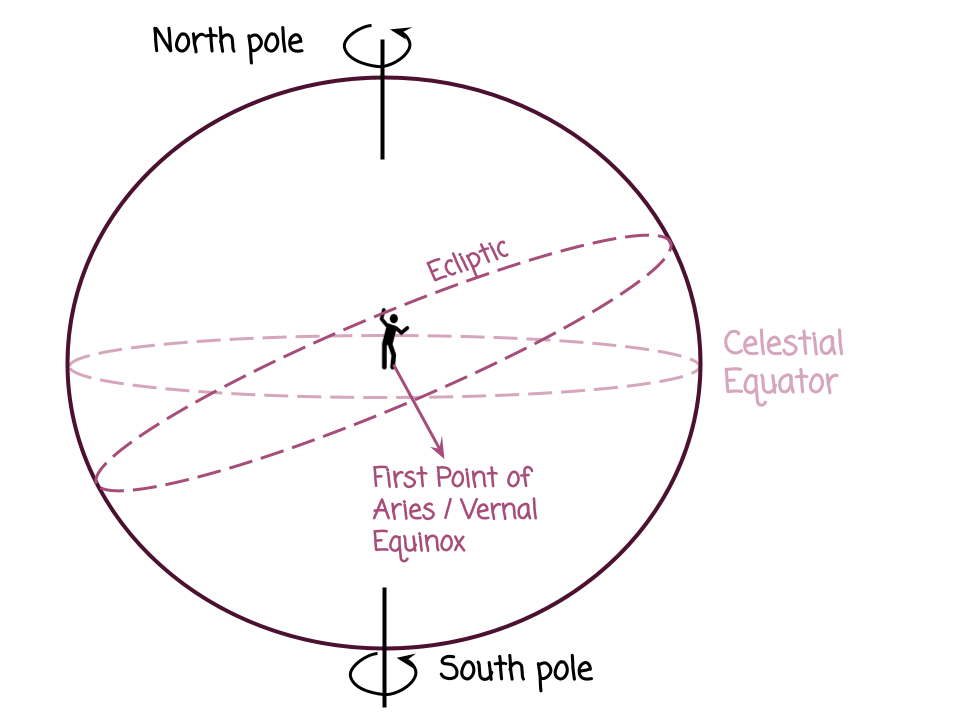
Below is a diagram with an opaque Earth. You can see the zero point a bit more clearly. Right ascension is defined using hours, minutes, and seconds.
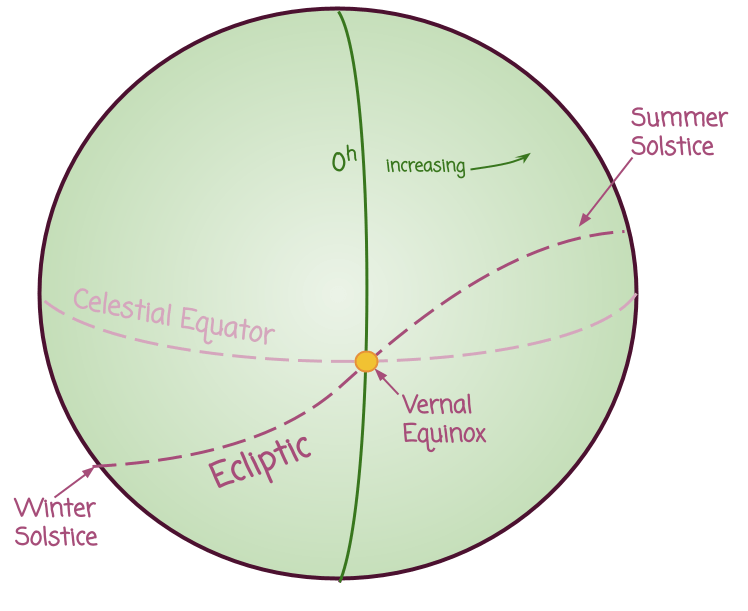
Zero hours is the First Point of Aries, and it increases eastward until 24 hours which is when the Earth makes a full rotation and is back at the zero point. Right Ascension is essentially based on Earth’s rotation, which is why it’s measured in time and not degrees (although they’re both useful!)
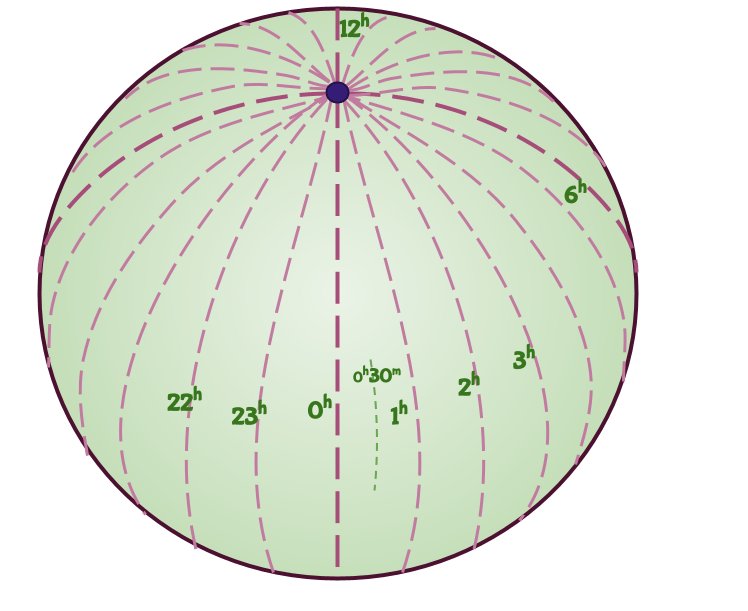
Right ascension is given the Greek symbol alpha α.
Hour Angle
There are a couple versions of hour angle, but it’s essentially reverse right ascension. Local hour angle is defined as:
Local Hour Angle = Local Sidereal Time – Right Ascension
This hour angle depends on where you are in addition to the star, since your sidereal time changes with longitude. There is also the Greenwich Hour Angle, which uses Greenwich Sidereal Time as a replacement. This can be useful since Greenwich defines the prime meridian and longitude.
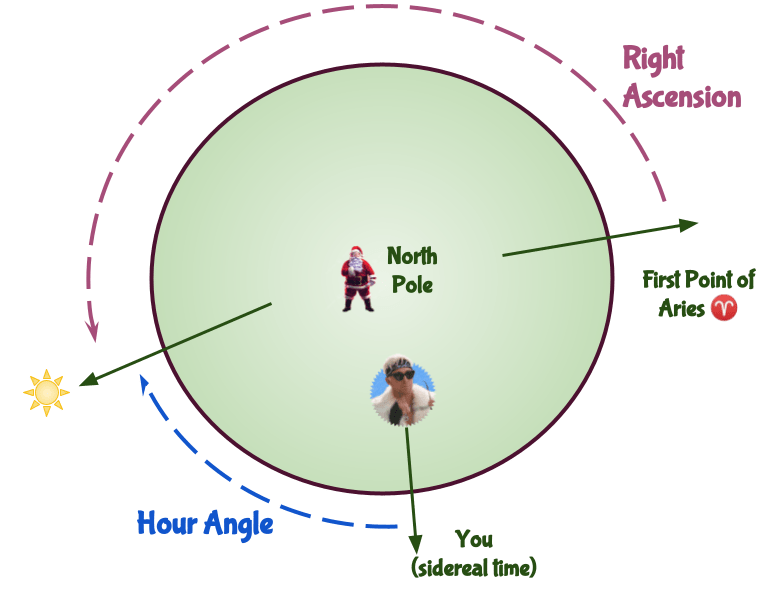
Another note is that Hour Angle is usually in degrees and travels in the opposite direction to right ascension.
If you’re still confused, don’t worry! I’ve never met an astronomer that uses hour angle unless it’s already programmed in a computer, we like right ascension and longitude far better!
That’s all for this post, see you next week for more space stuff!
 Space With Seti
great post, i especially loved how you used an actual picture of me for the hour angle diagram #canyoufeelthekenergy #iamkenough #ken
LikeLiked by 1 person
I really should work on learning these terms, or at least some of them. As a telescope owner, it’s a little embarrassing when I have to admit I don’t know any of the terminology. I just know some of the constellations and try to point my scope in the right direction based on that.
LikeLiked by 1 person
Oh don’t worry about not knowing a lot of these, it took me until my degree to learn about them! Most amateur astronomers don’t, especially hour angle! I tend to only use latlong but I make sure to have just a basic general awareness of the others so that when I look things up I can roughly guess where something would be.
LikeLiked by 1 person