If you were to ask me what is one of my favourite spacecrafts of all time, I would definitely say Gaia! But unfortunately Gaia has just run out of fuel and has come to the end of her observing lifetime, so this article is dedicated to celebrating Gaia and all of her achievements!
So What is Gaia and How Does it Compare?
As much as I love James Webb, I have to admit it gets a lot more attention than other telescopes which means spacecrafts like Gaia don’t get as much love from the public. So let me bring you up to speed on what Gaia is and its observing capabilities!
Gaia is an observatory based in the L2 Lagrange point (that’s a space-based orbit where the Earth is always blocking the Sun) that was launched in December 2013. Its main purpose is to observe stars in the Milky Way and measure properties like their kinematics and motion around the galaxy. It did also observe a bunch of active galaxies (galaxies where the central supermassive black hole is feeding and releasing loads of energy), but those aren’t the main goal of Gaia.
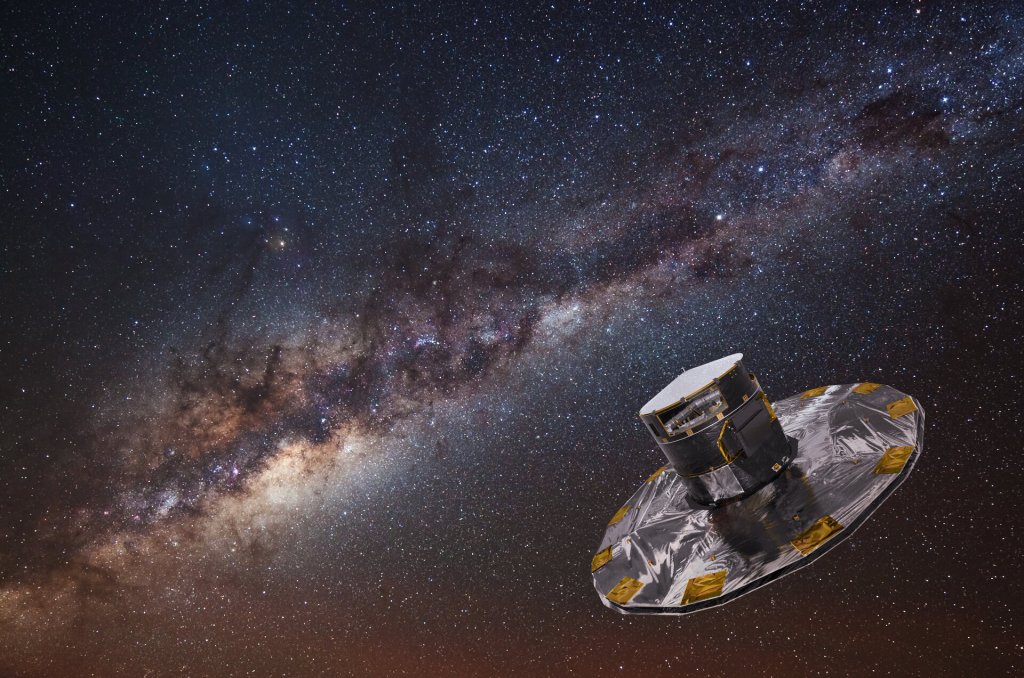
On board Gaia are three main instruments: its astrometer, photometers (both blue and red), and its radial velocity spectrometer which have measured stellar positions, proper motions, colours, and line-of-sight (LOS) velocities (and way more parameters) for about 1.8 billion stars in the Milky Way! Some of these stars won’t have all of those mentioned measurements (e.g LOS velocities and chemical abundances), but we’ll have to wait for data release 4 due next year to get the full picture of what Gaia has observed.
Gaia covers a fairly wide range of wavelengths or “colours” in which it observes, ranging from 330nm (Ultra Violet) to 1050nm (Near Infrared) which is actually one the largest ranges we’ve got so far for photometry, but its spectrometric capabilities are slightly less (about 400 nm to 900nm which is optical + near infrared). Combined with the fact that it’s one of the very few space-based observatories and thus doesn’t have issues with scattering of the Sun’s light, that’s a very impressive range if I must say!
The main thing about Gaia that I personally find great is the fact that it has all-sky coverage, whereas other observatories of the same kind are limited to varying degrees. If we compare it to other photometric surveys, the PanSTARRS telescope based in Hawai’i has measured 3 billion stars but only has 75% sky coverage and has a slightly smaller wavelength range (400 to 1030). The Sloan Legacy Survey observed a similar number stars to Gaia, but covers only a third of the Sky.
What have We Learnt from Gaia?
It would be impossible to go through every paper that has used Gaia data, but there are some key insights that we’ve been able to discover through Gaia.
Firstly, we have the most detailed 6D map of the Milky Way’s stars (that’s their positions and velocities), which has really boosted our view of stellar motion. Importantly, Gaia is quite precise with its measurements of kinematics of stars close to us, so our view of the Solar neighbourhood has been vastly improved. This has, of course, opened up a can of worms regarding stellar angular momenta and revealed some interesting phase spiral patterns which we don’t know much about yet, but I think we may have to discuss that in a later article!
The velocities of stars can also teach us about past collisions and if the galactic disk is in equilibrium (which it’s not), or even if a group of stars actually was born in the Milky Way or not! In an isolated disk the stars should just orbit in a circle, but if there’s a large group of stars which aren’t quite doing that and might be moving into or out of the disk, then there’s reason to believe they aren’t originally from the Milky Way. This exact thing was discovered with Gaia Data, and lead us to find candidate stars for the now dead and gone Gaia Sausage/Gaia Enceladus galaxy, a dwarf satellite that’s collided and was engulfed by the Milky Way. It’s called the Gaia Sausage because if you look at the velocities of these candidate stars, they create a sausage shape that stands out from the native Milky Way stars.
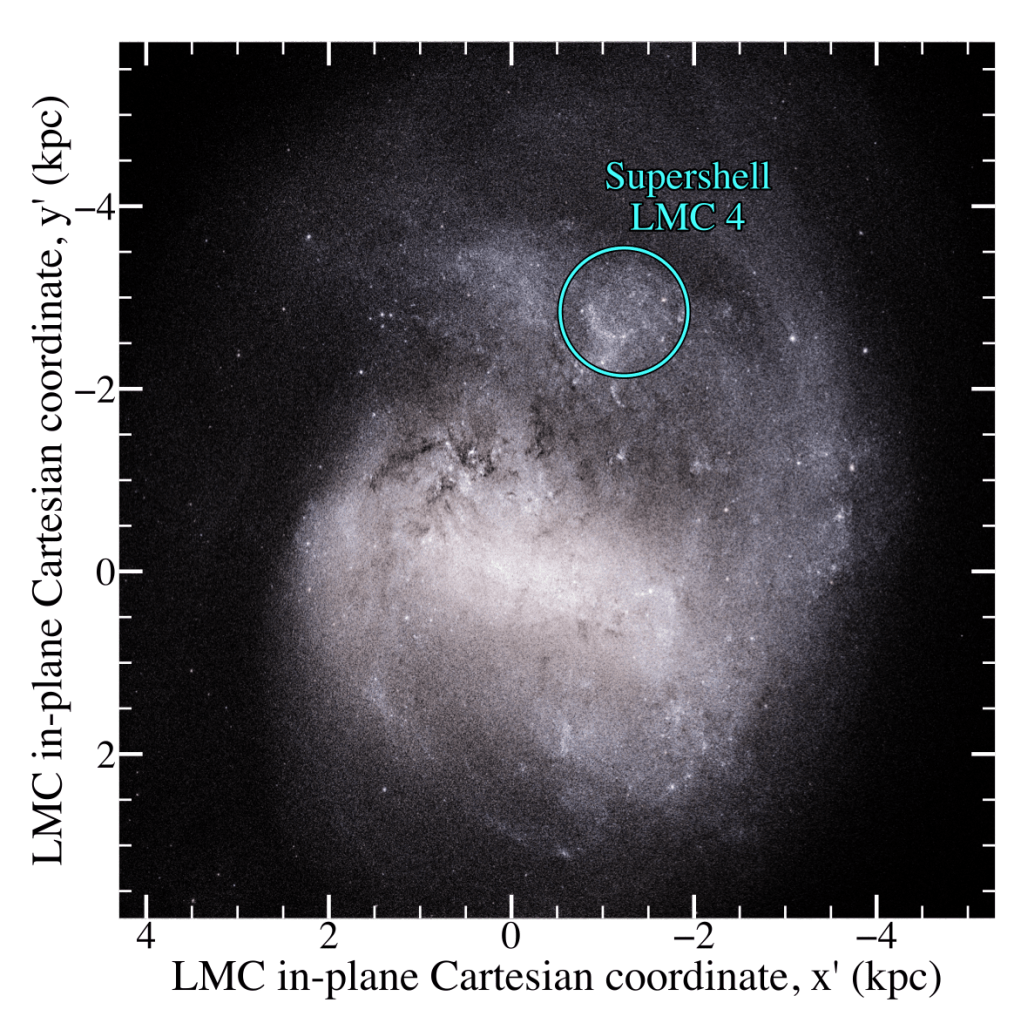
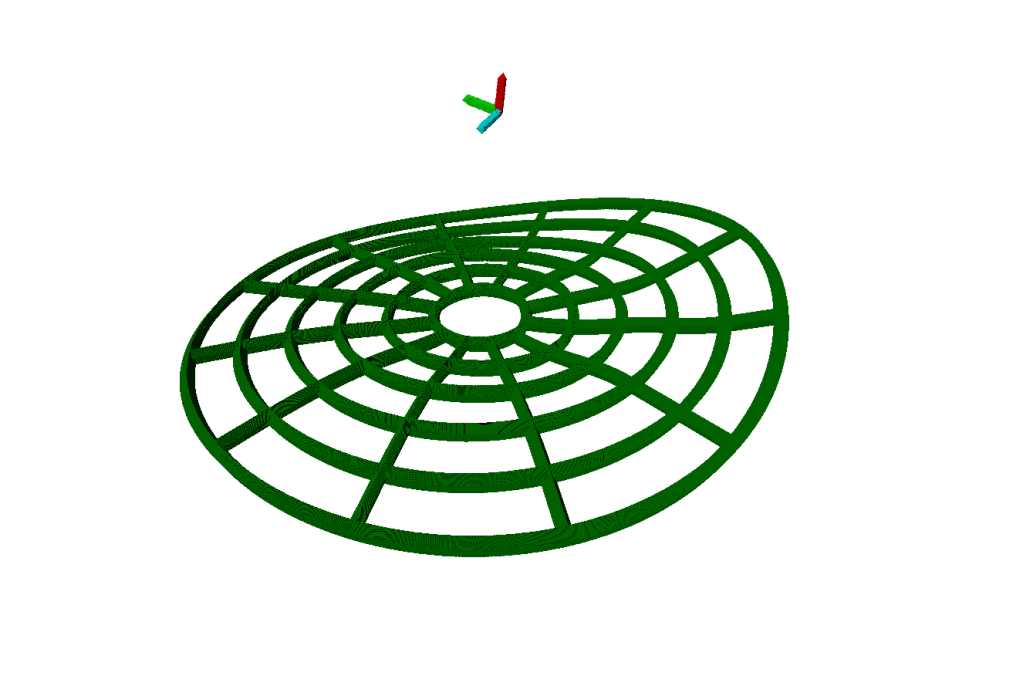
Another aspect I particularly am fond of is that alongside Gaia Sausage candidates, we are able to better select candidates from the Large Magellanic Cloud (LMC). The LMC presents a slightly larger challenge because it’s far away (50 kpc away), but if you combine LOS velocities from Gaia with those from APOGEE you can get a pretty sizeable dataset! This was done in a very recent paper by Ó. Jiménez-Arranz et al, and they were able to create a really stunning kinematic map of the LMC and show that it is also warped just like the Milky Way! The LMC’s warp is way more complex than a typical sinusoid, there’s a little bump on one side which matches up with a very odd bubble known as the super shell LMC 4. Below is a link to a 3D interactive map that Jiménez-Arranz made that you can drag and rotate yourself!
Finally, and most importantly, Gaia has shown us how little we know about galactic disks. Why is there a phase spiral? Why is the disk relatively cold? Why is our warp asymmetrical? We don’t know yet, but perhaps in the future we’ll get some answers!
If you want to read more on Gaia, I highly recommend this review published a couple weeks ago by Hunt & Vasiliev. It’s a chunky paper, but very insightful! I also recommend if you want to read more on the galaxy as a whole, this review from 2016 covers a lot areas of the Milky Way. They both also have a good list of references if you want to read further.
You can find more info on Gaia’s data release 3 here.
 Space With Seti
I think the one that hit me hardest was the end of the Cassini mission. The Opportunity Rover also affected me, because it felt like that rover was going to last forever and then suddenly it was gone. Space missions are a little like pets. You can’t help but get emotionally attached to them, and you feel it when they’re gone.
LikeLiked by 1 person
I was also really upset by Opportunity, it genuinely did feel like losing a pet to an illness. I was heartbroken, but I guess animizing things is just human nature :’)
LikeLiked by 1 person