A recent report by the European Southern Observatory (ESO) has unveiled worrying results on the impact of a potential nearby industrial complex. The INNA project, owned by INNA Soluciones Renovables SpA, is a proposed renewable energy plant looking to provide Chile with environmentally-friendly hydrogen and ammonia, but talks are underway to expand production to include solar and wind energy as well.
INNA’s purpose is to support Chile and local communities in their clean energy goals, which is a fantastic move in the right direction for environmental sustainability and an economic boost for the country.
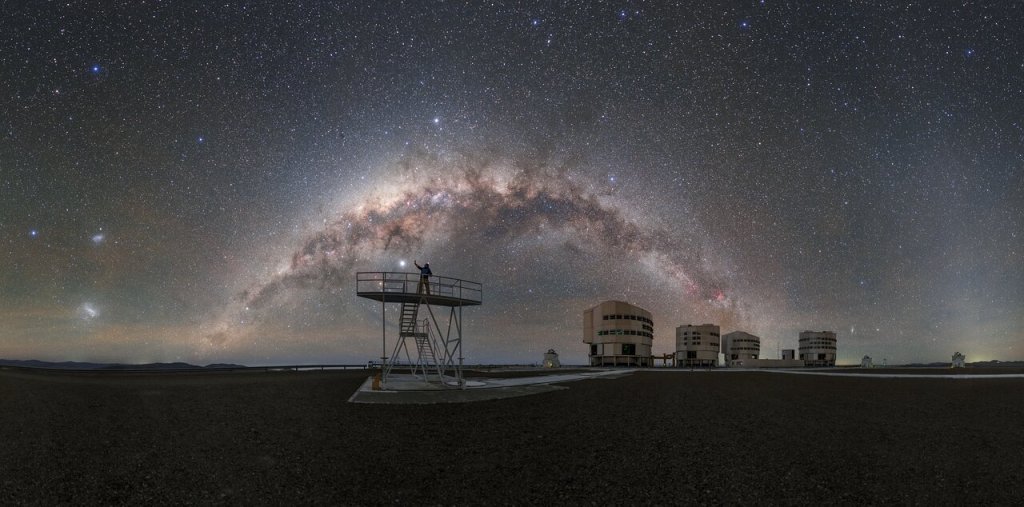
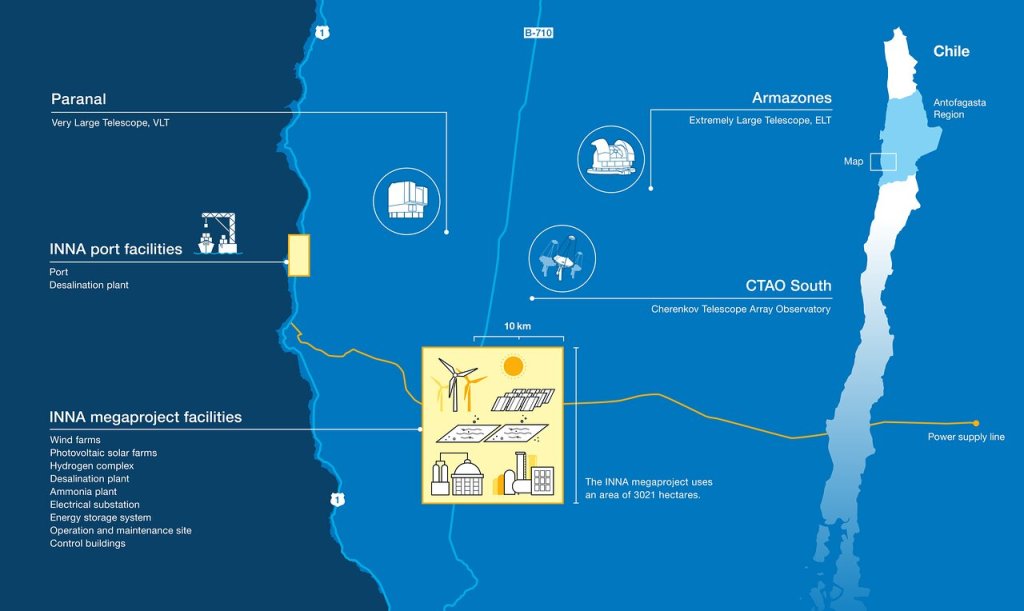
That being said, INNA’s location could be disastrous for astronomy researchers across the globe. Current plans for the megaproject show it’ll be sitting by Cerro Paranal, Antofagasta. This means it will be sharing a home with the Paranal Observatory, home to the Very Large Telescope (VLT), Cherenkov Telescope Array Observatory (CTAO), and the upcoming Extremely Large Telescope (ELT). The image below (courtesy of ESO) shows the proximity of the observatory to the megaproject, with CTAO in particular being only a few kilometers away!
Why is This a Problem?
Paranal is currently home to some of the clearest skies on the planet, with light pollution and atmospheric conditions having a relatively small impact on observations. But the addition of the INNA megaproject will completely eradicate these ideal conditions.
The analysis by ESO conclude that light pollution will increase by 50% above CTAO-South, and 35% above the VLT. Even worse, turbulence and physical disruption to the area during the production and operation of the power plant is guaranteed to accelerate the degradation of observations and further damage equipment.
This is going to be disastrous for the VLT and CTAO, which have precise equipment highly sensitive to seismic activity such as the interferometers built in to the VLT system.
This could be very worrying for the future of science research. March hasn’t even ended yet and we’ve already seen 10+ papers that have used VLT data alone. The Paranal Observatory is home to some of the best telescopes in the world, and it would be horrible to lose them!
Personally, I think both INNA and the Paranal Observatory are indeed important for Chile’s economic and technological growth, and it’s very possible for Chile to have both and simply relocate INNA as it hasn’t even been built yet. And relocation is precisely what ESO are arguing for, with General Xavier Barcons, director at ESO, suggesting that “Both are declared strategic priorities by the country and are fully compatible — if the different facilities are located at sufficient distances from one another.”
Let’s hope that Chile, ESO, and INNA can come to a compromise and preserve the future of astronomy and green energy!
Further Information & Resources
ESO’s most recent press release: https://www.eso.org/public/news/eso2506/
Paranal Instrumentation: https://www.eso.org/sci/facilities/paranal/instruments.html
AES INNA Project Evaluation: https://www.aesandes.com/en/press-release/aes-andes-submits-environmental-impact-assessment-project-inna
 Space With Seti
Excellent summary, Seti, looking forward to hearing more on this and whatever else tops your list!
LikeLiked by 1 person
Thank you Ron!
LikeLike
After so much money has been invested in ESO, it makes no sense to mess it up now. I’d be really shocked if Chile allowed this to happen.
LikeLiked by 1 person
Yes you’re totally right. I’m sure they’ll come to a compromise with the location though, the power plant is still in the concept stage so nothing is currently being built yet.
LikeLiked by 1 person