It’s the moment we’ve all been waiting for, the Euclid Consortium have released a new selection of amazing images, and we can all enjoy what this powerful telescope has to offer!
Let’s just have a quick refresher on Euclid and its purpose. Euclid is a space-based telescope designed for visible and near-infrared light, similar to JWST but slightly shifted towards bluer wavelengths. This wide range of light allows it to calculate redshifts for a vast amount of galaxies, primarily in deep space. Its key strengths are its wide field-of-view and spectacular resolution, which will enable scientists to see more galaxies and get a better view of large-scale structure in the universe. Alongside improvements to our understanding of the cosmic web, Euclid’s will shed light on other topics such as dark energy, dark matter, and gravitational lensing.
Okay, now let’s look at my favourite images from Euclid so far!
Cat’s Eye Nebula

The Cat’s Eye Nebula is a popular planetary nebula among amateur astronomers (with the right telescope), and was key in distinguishing planetary nebula against regular nebula and supernova remnants.
You might not know this, but a lot of images of the Cat’s eye are not made with visible light observations! Within the nebula is a dying Wolf-Rayet star which releases large amounts of energy into the surrounding gas, migrating it outward into its distinct shells but also heating and ionising it. This means it’s a remarkably good target across the electromagnetic spectrum but especially for X-ray. So a lot of images you see have multiple wavelength bands stacked on top of each other and colorised.
Euclid’s image, however, is a little more selective due to the telescopes much narrower range of wavelengths. This image includes only the optical and near-infrared, and you can see the nebula isn’t as colourful but the resolution is amazing!
You can download larger images here.
Euclid Deep Field South – Zoomed in 70 x
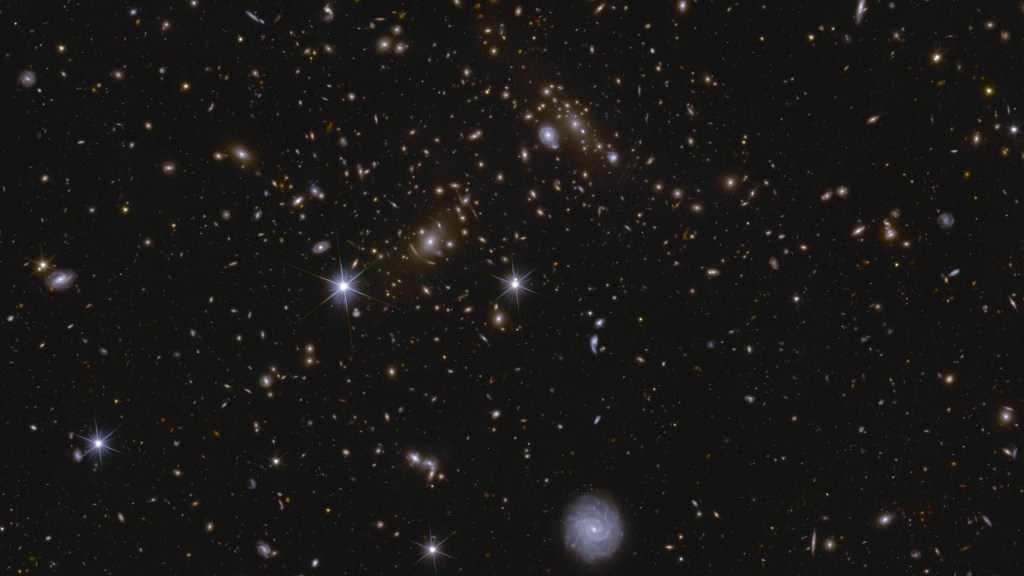
This is a screensaver-worthy image! Above is a zoom in of one of Euclid’s big mosaics, showcasing many unique structures like galaxy clusters hosting galaxies of varying types and distances, but also a lot of gravitational lensing!
10 years ago, little me would have never thought we’d see this much gravitationally lensed galaxies in just one image! Now they’re everywhere!
I was interested in the spiral galaxy at the bottom of the image, but I couldn’t find anything about the cluster based on the name (J041110.98-481939.3), so I’ll have to dig a little deeper on that later!
You can download larger images here.
The Horse Head Nebula
Okay, this image was released 2 years ago and was one of the first images from Euclid. I’m still including it because it’s amazing to look at!
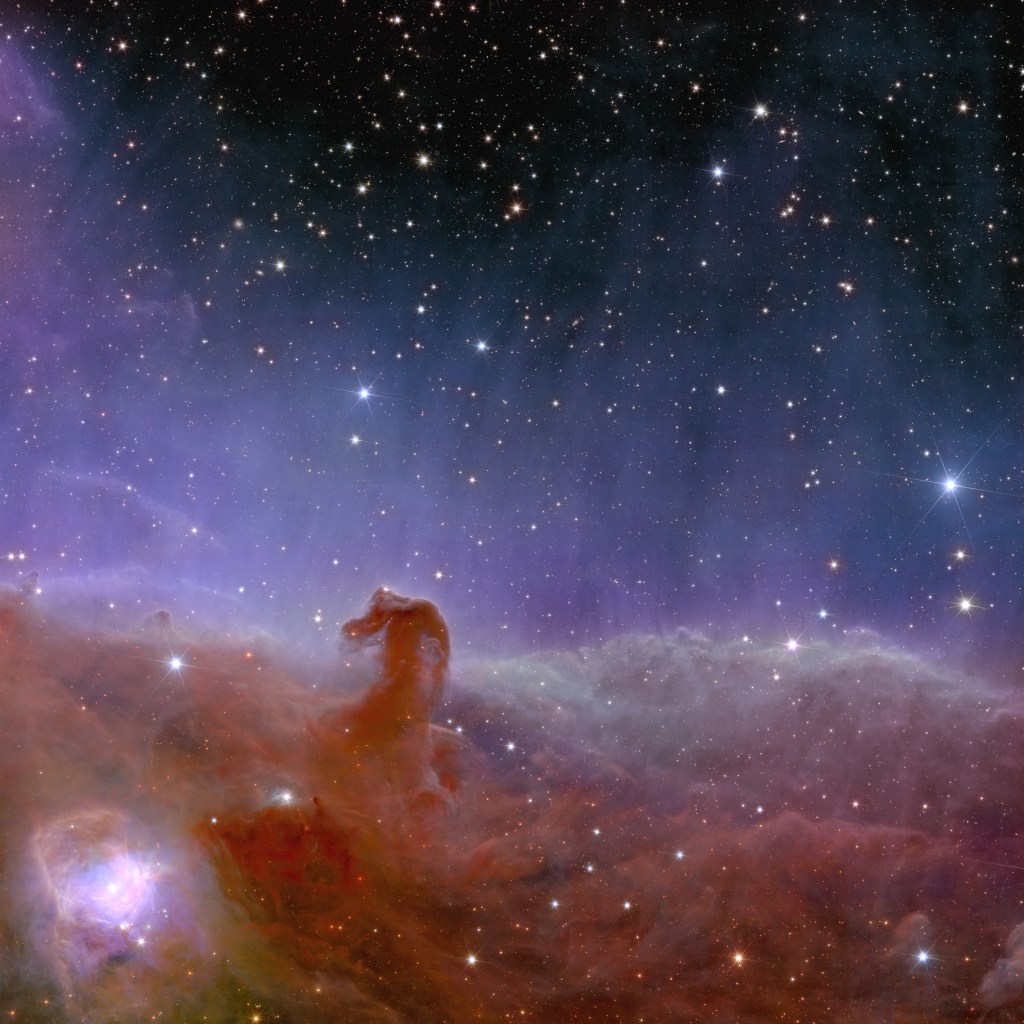
A little closer to us, the Horse Head Nebula is a perfect example of a dark nebula. This patch of the sky is particularly interesting because we expect it be a site of star formation, particularly low-mass stars like brown dwarfs. Behind the horse head is hydrogen gas, ionised by the brightest star in Sigma Orionis. With Euclid, this is the purple mythical-looking background, featuring faint streaks created by the star’s magnetic field.
The horse head contains a lot of thick heavy dust and cold molecular hydrogen, which is why it blocks the light coming through. It looks a little more translucent in this image compared to images by other telescopes, likely because A: they didn’t up the contrast in the editing process, and B: near-infrared is slightly better at piercing though dust than blue or ultraviolet light.
You can download larger images here.
Now for a real treat!
Finally, I wanted to share this amazing website for you to explore Euclid’s data even more!
ESA have a zoomable version of Euclid’s deep field images that you can play around with and view the hundreds of galaxies in much better detail!
Have a look at it here.


I’m so used to seeing the Horsehead Nebula with pink or red in the background. I like the purple. It gives it even more of a dreamy quality, I feel.
LikeLiked by 1 person
I definitely agree, they have a very whimsical dreamy look!
LikeLiked by 1 person